Chargement...
Complete guide
Common trout
Overview
The common trout, also known as brown trout, is one of the most sought-after fish species by sport anglers in Quebec. Valued for its fighting spirit and ability to provide great battles, it attracts many fly and spin fishing enthusiasts. Primarily found in cool rivers and deep lakes, the common trout is a fish that requires a strategic approach to be caught. Its distribution is quite wide, extending to various watersheds in Quebec, making it a prime target for anglers seeking challenges and trophies. With its ability to adapt to different environments, it offers a diverse and exciting fishing experience.
Angler indices
Identification
Identification
The common trout is distinguished by its fusiform and elongated body, often more robust than that of its cousins, the rainbow trout or the brook trout. Its color varies from golden to olive brown, sprinkled with black and red spots surrounded by white, particularly visible on the flanks. The mouth is wide, with powerful and slightly curved jaws, especially in adult males. The dorsal and caudal fins are also dotted with small black spots. The scales are small and smooth, providing a shiny appearance when the fish is out of the water. Young trout, called fry or parr, often display darker vertical bands, while males during spawning season develop brighter colors and pronounced kypes.
How to tell it apart
A few subtle differences allow for the distinction between common trout and rainbow trout.
| Criterion | Common Trout | Rainbow Trout |
|---|---|---|
| Size | Up to 80 cm | Up to 70 cm |
| Color | Olive brown with red spots | Silver with a pink band |
| Fins | Spotted with black | Generally unspotted |
Distribution in Quebec
Distribution in Quebec
The common trout is widespread in several regions of Quebec, notably in the watersheds of the Matapédia, Bonaventure, and Restigouche rivers in Gaspésie. It is also found in certain parts of the Côte-Nord and in the lakes of Estrie and the Laurentians. Although it prefers clear and well-oxygenated waters, it also adapts to deep lakes and rivers with moderate currents. Its abundance varies by region, but it is generally well established where conditions are favorable.
Habitat
Habitat
The common trout favors the cool and well-oxygenated waters of rivers and lakes. It prefers areas where the current is moderate, with structures such as rocks, submerged tree trunks, and aquatic vegetation that provide shelter and hiding spots. It is often found at depths ranging from a few meters to over 10 meters, especially in summer when surface temperatures rise. Shaded areas and deep pools are prime spots to search for it.
Life cycle
Life cycle
The life cycle of the common trout begins with spawning, which typically occurs in the fall in rivers with gravel bottoms. Females dig nests called 'redds' where they lay their eggs. After hatching in the spring, fry remain in shallow areas until they reach a sufficient size to face stronger currents. They grow quickly during the first months, reaching sexual maturity around 2 to 3 years. The lifespan of common trout can reach 12 years, although most do not live that long due to predation and fishing. Spring → Spawning (fall) → Hatching (following spring) → Growth → Maturity → Spawning (fall)
Behaviour
Behaviour
The common trout is primarily solitary and territorial, especially adult individuals. It aggressively defends its territory against intruders, making it sometimes difficult to catch. Sensitive to changes in light and weather, it is more active during overcast conditions or at dusk. Loud noises and vibrations can scare it away, highlighting the importance of a discreet approach when fishing.
Diet
Diet
The diet of the common trout varies by age and season. Fry primarily feed on zooplankton and small aquatic invertebrates. As they grow, their diet expands to include insects, small fish, crustaceans, and occasionally amphibians. In summer, they are particularly fond of terrestrial insects that fall into the water, while in autumn, they focus more on small fish and benthic invertebrates.
Seasons & best times
Seasons & best times
In spring, the common trout is active as soon as the ice melts, seeking to feed intensively after winter. The best times to fish for it are early in the morning and late in the afternoon. In summer, it takes refuge in deeper and shaded waters to avoid the heat, and it is often more effective to fish for it with sinking lures or flies. Autumn is a time of great activity as it prepares for spawning, making cloudy days particularly favorable. In winter, ice fishing is possible, but it requires a patient and subtle approach.
Fishing techniques
Fishing techniques
Fly Fishing
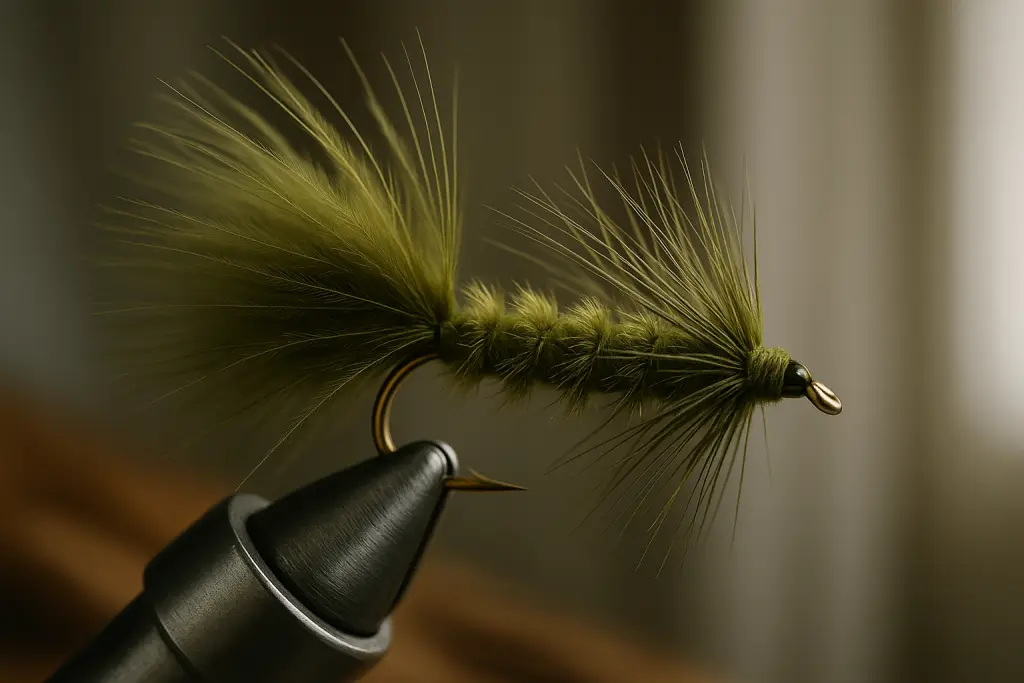
Ideal in spring and autumn, this technique allows you to mimic surface insects. Use dry flies or nymphs. Be careful to adjust your leader line so that it is nearly invisible.
Spoon Fishing
Effective in deeper or faster waters. Let the spoon sink before slowly retrieving it to mimic a distressed small fish. Avoid overly fast retrieves.
Light Tackle Fishing
Use soft lures or small swimming fish. Suitable for areas with a lot of vegetation cover where trout hide.
Trolling
Particularly useful in summer in deep lakes. Use sinking lures or spoons. Adjust the boat speed to keep the lure at the right depth.
Bait Fishing
Simple but effective, especially for beginners. Use a worm on a single hook with a light weight. Ideal for calm and shallow waters.
Lures & colours
Recommended lures & flies
In clear water, favor natural colors like brown, green, or silver. In overcast conditions or murky water, bright colors like yellow or red may be more attractive. In depth, use lures with metallic reflections to catch the light.
Recommended gear
Recommended gear
Opt for a fishing rod of 7 to 9 feet with a moderate to fast action for good sensitivity. An open-faced reel size 2000 to 3000 is ideal. Use a 6 to 10 lb line in monofilament or fluorocarbon for more discretion. Hooks size 6 to 10 are generally suitable, with a leader line of 2 to 4 lbs for fly fishing.
Handling & release
Handling & release
For a successful release, handle the trout carefully, avoiding touching its gills. Use a knotless net to minimize damage to the scales. Be quick for the photo and ensure it is well oxygenated before releasing it.
Predators
Predators
The main predators of the common trout include birds of prey such as the osprey and the bald eagle, as well as mammals like otters and minks. In the water, large pike and muskellunge can also target young trout.
Conservation & status
Conservation & status
In Quebec, the common trout is well managed through regulations on minimum sizes and catch quotas. It is crucial to respect these rules to ensure the sustainability of populations. Catch-and-release is strongly encouraged for large specimens to maintain good genetics within populations.
Surprising facts
Surprising facts
- ›The common trout can live in saltwater and migrate upstream to spawn.
- ›It was introduced to North America in the late 19th century.
- ›Common trout can develop very bright colors during spawning.
- ›They are known for their intelligence and ability to avoid experienced anglers.
- ›The common trout has a highly developed sense of smell.
- ›They prefer waters with a pH that is neutral to slightly alkaline.
- ›Common trout can be cannibalistic, especially in overcrowded environments.
- ›They have a vision adapted to low-light environments.
- ›The common trout is one of the most adaptable fish, living in varied climates.
- ›During spawning season, males develop a kype on their lower jaw.
- ›Common trout can jump up to 3 meters to overcome obstacles.
- ›They are often used as indicators of water quality due to their sensitivity to pollution.
Frequently asked questions
Frequently asked questions
What is the best time of year to fish for common trout in Quebec?+
What are the best baits for common trout?+
Is common trout sensitive to temperature changes?+
Can you fish for common trout in winter?+
How can you recognize a common trout during spawning?+
What is the average size of a common trout in Quebec?+
Is common trout a good fish for consumption?+
What are the main predators of common trout?+
Is common trout an invasive species in Quebec?+
What type of fishing rod is recommended for common trout?+
What is the lifespan of a common trout?+
Is it legal to fish for common trout year-round?+
Can common trout survive in polluted waters?+
What is the best time of day to fish for common trout?+
Can you fish for common trout in lakes?+
Member catches
No catches yet for this species. Be the first!
Have you caught common trout?
Share your photo with fellow anglers — show off your catch!
Be the first to share your catch of this species.
Our picks
Gear for Common trout

Sidomma Pro Fishing Gear
Discover the complete Sidomma fishing tool set, designed to meet the needs of anglers at all levels. Whether you are…
40.99 $

Doryum Fish Hooks 600 PCS
Discover the complete Doryum fishing hooks set, designed to meet all your fishing needs. With 600 eyed fishing hooks…
12.54 $

TRUSCEND
Fishing Lures and Gear Kit
Discover our exceptional fishing lures set, which includes colorful lures, sharp hooks, and various fishing gear, mak…
29.99 $