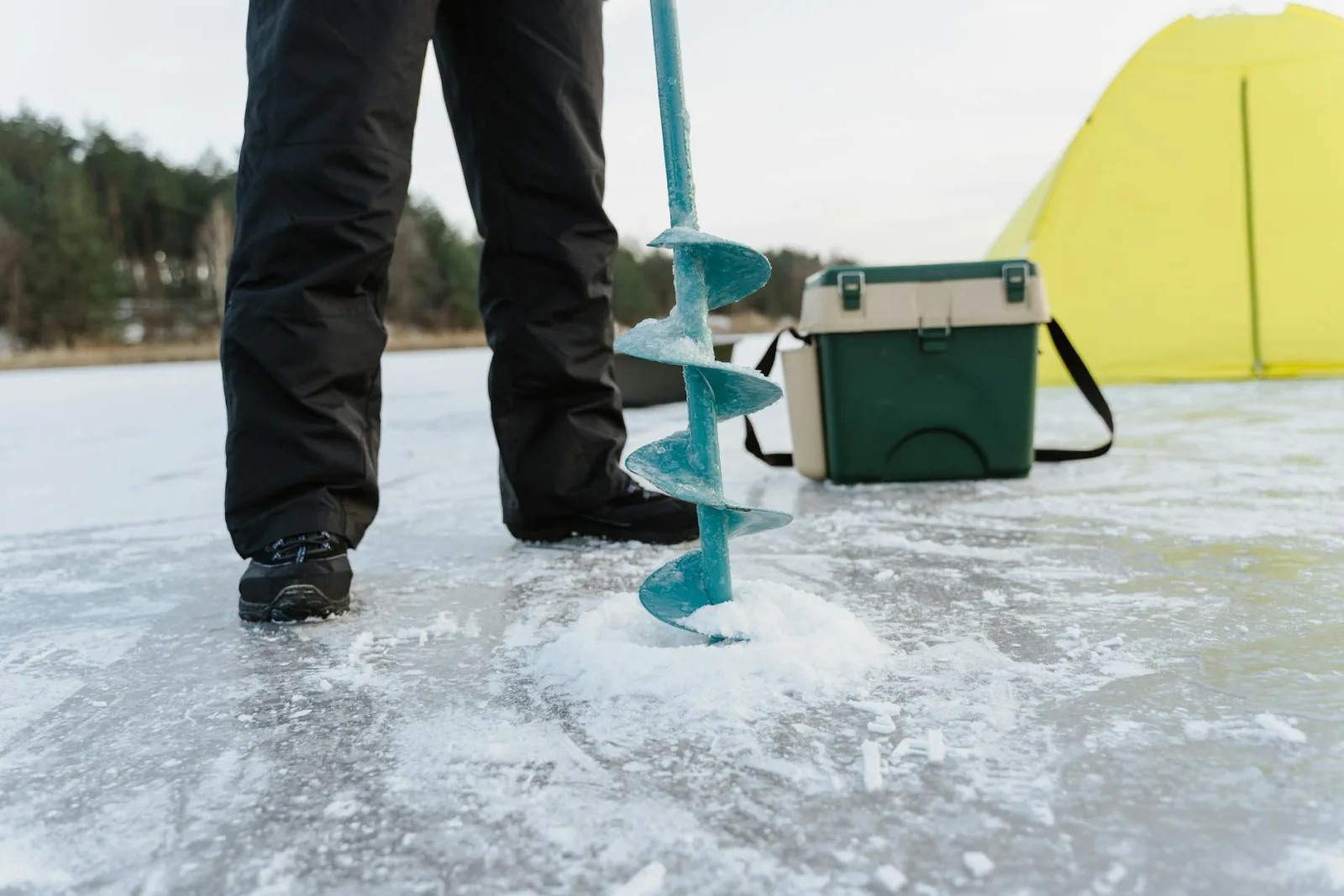
A mild autumn delays ice formation, but it doesn't delay the opening date. In twelve regions of Quebec, ice fishing opens on December 1st, and in seventeen others on December 20th — whether the ice is there or not.
That's the whole problem this season. The regulation gives a date; the ice does not comply. Here's how to judge, with the official thresholds.
Recommended Thicknesses by the Lifesaving Society
The Lifesaving Society publishes a minimum thickness chart. It carries an essential precision, noted under the title: these figures are "based on new and clear ice".
| Thickness | Allowed Activity |
|---|---|
| 7 cm (3 in) or less | Do not venture |
| 10 cm (4 in) | Ice fishing, walking, cross-country skiing, skating |
| 12 cm (5 in) | Snowmobiling, ATV |
| 20 to 30 cm (8 to 12 in) | Automobile |
| 30 to 38 cm (12 to 15 in) | Medium-duty truck |
Remember the first number: 10 centimeters for fishing. Not 7, not 8. And especially remember the condition: new and clear ice.
Why Color Matters as Much as Thickness
This is the point that most guides gloss over, and it's precisely the one that matters after a mild autumn.
The Lifesaving Society states it bluntly: "The same thickness does not necessarily mean the same strength when the ice is clear and newly formed, white and porous, or deteriorated by thawing."
Three colors, three behaviors:
- Blue or clear ice — "Newly formed and uniform blue or clear ice is generally stronger than ice containing a lot of air or that has undergone several freeze-thaw cycles." This is the ice on which the chart is calibrated.
- White and opaque ice — "White and opaque ice, sometimes called snow ice, contains more air. Its strength can vary considerably depending on its composition and density."
- Gray ice — "Gray ice generally indicates the presence of water caused notably by melting. It should be considered dangerous."
In other words: your 10 centimeters of white ice are not worth 10 centimeters of blue ice. And 10 centimeters of gray ice are worth nothing at all.
What a Mild Autumn Changes Concretely
A late freeze does not only delay ice formation. It changes its nature.
Freeze-thaw cycles create bad ice. Ice that freezes, partially melts, then refreezes does not have the structure of ice formed in one piece by sustained cold. The Lifesaving Society explicitly states: ice "that has undergone several freeze-thaw cycles" is less strong at the same thickness.
Water stays warm longer. Ice forms when the surface water column reaches freezing point. A mild autumn leaves more heat in the water body, delaying freezing and first producing a thin and irregular layer.
Snow falling on thin ice is a double trap. It insulates — which slows thickening — and it hides the condition of the surface. A layer of snow on 6 centimeters of ice looks exactly like a layer of snow on 30.
The Four Rules That Never Change
- Measure, do not guess. Drill several holes as you progress. Thickness varies greatly over the same water body — a measurement at the edge says nothing about what is happening a hundred meters away.
- Beware of currents. Mouths, straits, lake outlets, spring areas: the ice is systematically thinner there, sometimes by half, and the surface appearance is identical.
- Never go alone, and tell someone where you are going. The Lifesaving Society reminds us that an average of seven drownings per year occur in Quebec due to ice.
- A closed surface remains closed. "A closed surface or one with uncertain conditions should never be used."
And What About Opening Dates?
The regulatory date allows fishing; it does not certify the ice. The twelve regions opening on December 1st and the seventeen opening on December 20th have nothing to do with the conditions of the year.
To know the date for your area and the number of lines allowed, check our guide on ice fishing dates by area.
And for the actual state of the ice, there is only one source worth it: the outfitters, clubs, and fishing villages in your area, which measure daily. No article — this one included — can tell you if the ice is safe today on your lake.
Source
The thickness thresholds and color descriptions come from the Lifesaving Society of Quebec (sauvetage.qc.ca), consulted on November 22, 2026: poster "Recommended Minimum Ice Thickness" and ice advice pages.
?Frequently asked questions
What thickness of ice is needed to fish?
Why is the color of the ice important?
What thickness is required for a snowmobile or ATV?
Does a mild autumn delay the opening of ice fishing?
Go further
Buyer’s guides